

Residential Garden · London, 2024
Residential Garden · London, 2024
Designing landscapes with clear and purpose
Designing landscapes with clear and purpose

James Carter
Founder & Lead Designer
Published
Reading time
9 min read
Structure is not the enemy of beauty in a garden. It is the precondition for it. Without a clear underlying framework — spatial, ecological, and experiential — even the most beautifully planted garden will feel restless, incoherent, and ultimately unsatisfying to live with.
- The Problem with Decoration
Why most gardens feel wrong even when they look right.
There is a persistent confusion in landscape design between appearance and structure. Many gardens are conceived primarily as visual compositions — collections of plants, textures, and colors arranged for photographic effect. They look extraordinary in April. By September they have collapsed into a tangle that no-one quite understands how to manage.
The problem is not the planting. The problem is that the spatial framework was never properly resolved. Without clear decisions about how space flows, where the eye travels, where the body instinctively wants to move and pause — even the most exquisite plant palette cannot create a garden that feels genuinely composed.
Key Principle
A garden is not a picture to be looked at. It is a sequence of spaces to be moved through, paused within, and experienced over time. The difference matters profoundly for how you design it.
Key Principle
A garden is not a picture to be looked at. It is a sequence of spaces to be moved through, paused within, and experienced over time. The difference matters profoundly for how you design it.
Structure is not the enemy of beauty in a garden. It is the precondition for it. Without a clear underlying framework — spatial, ecological, and experiential — even the most beautifully planted garden will feel restless, incoherent, and ultimately unsatisfying to live with.
- The Problem with Decoration
Why most gardens feel wrong even when they look right.
There is a persistent confusion in landscape design between appearance and structure. Many gardens are conceived primarily as visual compositions — collections of plants, textures, and colors arranged for photographic effect. They look extraordinary in April. By September they have collapsed into a tangle that no-one quite understands how to manage.
The problem is not the planting. The problem is that the spatial framework was never properly resolved. Without clear decisions about how space flows, where the eye travels, where the body instinctively wants to move and pause — even the most exquisite plant palette cannot create a garden that feels genuinely composed.
Key Principle
A garden is not a picture to be looked at. It is a sequence of spaces to be moved through, paused within, and experienced over time. The difference matters profoundly for how you design it.

A resolved spatial framework at Ashwood Estate — the structure was designed before a single plant was selected. The geometry works independently of the planting.
A resolved spatial framework at Ashwood Estate — the structure was designed before a single plant was selected. The geometry works independently of the planting.
The Three Layers of Structure
How we think about the framework of a landscape.
At Greenth, we approach landscape structure through three distinct but interdependent layers. Getting these right — in sequence — is what separates gardens that endure from those that deteriorate.
Spatial structure — how the garden is divided into rooms, how those rooms relate to each other, where the axes and views terminate, and how the human body is invited to move through the space. This is resolved first, before any plant is considered.
Ecological structure — the underlying soil and drainage framework, the canopy and sub-canopy layers, the seasonal rhythm of what is present and what recedes. A garden designed with ecological structure in mind will look after itself more gracefully than one imposed purely for visual effect.
Experiential structure — the sequence of compression and release, light and shade, the orchestration of scent and sound as you move. This is the layer most often neglected, and the one that makes the difference between a garden that is merely attractive and one that is genuinely memorable.
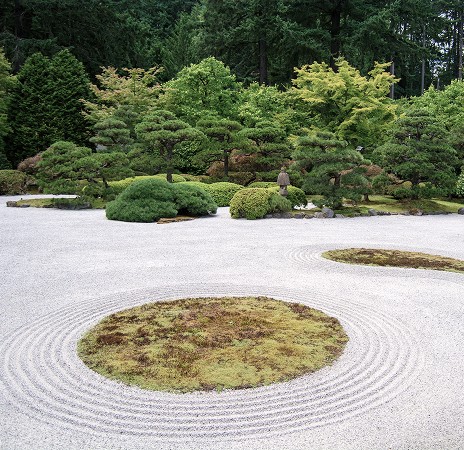
The spatial layer resolved first — paths, levels, and edges defined before planting.

The same garden with planting layered into the resolved framework — structure makes planting legible.
The spatial layer resolved first — paths, levels, and edges defined before planting.
The same garden with planting layered into the resolved framework — structure makes planting legible.
What resolving spatial structure actually looks like.
In practice, spatial structure resolution means answering a precise set of questions before any planting design begins. These are not abstract design questions — they are grounded in how the people who will use this garden actually live.
The questions we ask first
Where do people enter, and where do their eyes travel first? This determines the main axis and the single most important view to compose.
Where does the family actually spend time — morning, afternoon, evening? Gardens that ignore daily rhythm produce beautiful spaces that go unused.
How does the space need to feel different at different points? Tension between enclosure and openness, between formality and wildness, creates the experiential rhythm that makes a garden feel rich rather than monotonous.
What is the land itself asking for? Slope, soil type, aspect, existing mature trees — these are not obstacles to design, they are its most valuable raw materials.
87%
Our clients say their garden is used more than they expected
3X
Average increase in perceived garden size through spatial design
20yr
Time horizon we design for — not seasons, decades
87%
Our clients say their garden is used more than they expected
3X
Average increase in perceived garden size through spatial design
20yr
Time horizon we design for — not seasons, decades
What structure gives back?
A garden designed with genuine structural rigour gives something back that decoration alone never can: a sense of inevitability. The feeling, when you walk through a well-designed landscape, that it could not be otherwise — that every decision was right, and that the whole is greater than the sum of its parts.
This is the quality we chase in every project at Greenth. Not novelty. Not the most unusual plant palette or the most photographed composition. But the quiet satisfaction of a garden that works — spatially, ecologically, experientially — and that will continue to work and to improve long after we have handed it over.
That is what structure gives back. It gives you a garden that does not need to be constantly managed back from entropy. A garden that has its own logic, and that rewards every hour you spend within it. That is, ultimately, what good landscape design is for.
The Three Layers of Structure
How we think about the framework of a landscape.
At Greenth, we approach landscape structure through three distinct but interdependent layers. Getting these right — in sequence — is what separates gardens that endure from those that deteriorate.
Spatial structure — how the garden is divided into rooms, how those rooms relate to each other, where the axes and views terminate, and how the human body is invited to move through the space. This is resolved first, before any plant is considered.
Ecological structure — the underlying soil and drainage framework, the canopy and sub-canopy layers, the seasonal rhythm of what is present and what recedes. A garden designed with ecological structure in mind will look after itself more gracefully than one imposed purely for visual effect.
Experiential structure — the sequence of compression and release, light and shade, the orchestration of scent and sound as you move. This is the layer most often neglected, and the one that makes the difference between a garden that is merely attractive and one that is genuinely memorable.
The spatial layer resolved first — paths, levels, and edges defined before planting.
The same garden with planting layered into the resolved framework — structure makes planting legible.
What resolving spatial structure actually looks like.
In practice, spatial structure resolution means answering a precise set of questions before any planting design begins. These are not abstract design questions — they are grounded in how the people who will use this garden actually live.
The questions we ask first
Where do people enter, and where do their eyes travel first? This determines the main axis and the single most important view to compose.
Where does the family actually spend time — morning, afternoon, evening? Gardens that ignore daily rhythm produce beautiful spaces that go unused.
How does the space need to feel different at different points? Tension between enclosure and openness, between formality and wildness, creates the experiential rhythm that makes a garden feel rich rather than monotonous.
What is the land itself asking for? Slope, soil type, aspect, existing mature trees — these are not obstacles to design, they are its most valuable raw materials.
87%
Our clients say their garden is used more than they expected
3X
Average increase in perceived garden size through spatial design
20yr
Time horizon we design for — not seasons, decades
What structure gives back?
A garden designed with genuine structural rigour gives something back that decoration alone never can: a sense of inevitability. The feeling, when you walk through a well-designed landscape, that it could not be otherwise — that every decision was right, and that the whole is greater than the sum of its parts.
This is the quality we chase in every project at Greenth. Not novelty. Not the most unusual plant palette or the most photographed composition. But the quiet satisfaction of a garden that works — spatially, ecologically, experientially — and that will continue to work and to improve long after we have handed it over.
That is what structure gives back. It gives you a garden that does not need to be constantly managed back from entropy. A garden that has its own logic, and that rewards every hour you spend within it. That is, ultimately, what good landscape design is for.
James Carter
Founder & Lead Designer
James Carter founded Greenth in 2012 after completing his BSc in Horticulture and working under two of the UK's leading landscape architects. He leads all major design commissions and writes regularly on ecological design, spatial thinking, and the long-term behaviour of planted landscapes. He is an RHS medallist and a BALI-accredited practitioner.
James Carter
Founder & Lead Designer
James Carter founded Greenth in 2012 after completing his BSc in Horticulture and working under two of the UK's leading landscape architects. He leads all major design commissions and writes regularly on ecological design, spatial thinking, and the long-term behaviour of planted landscapes. He is an RHS medallist and a BALI-accredited practitioner.


